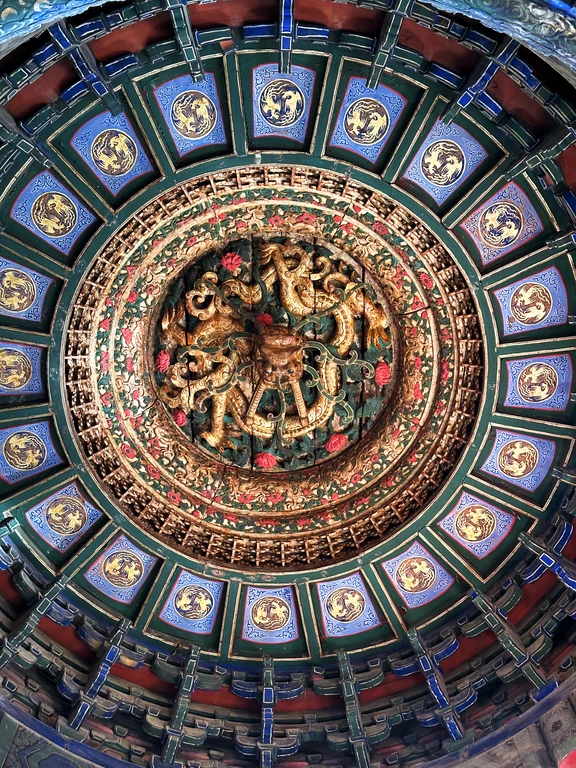
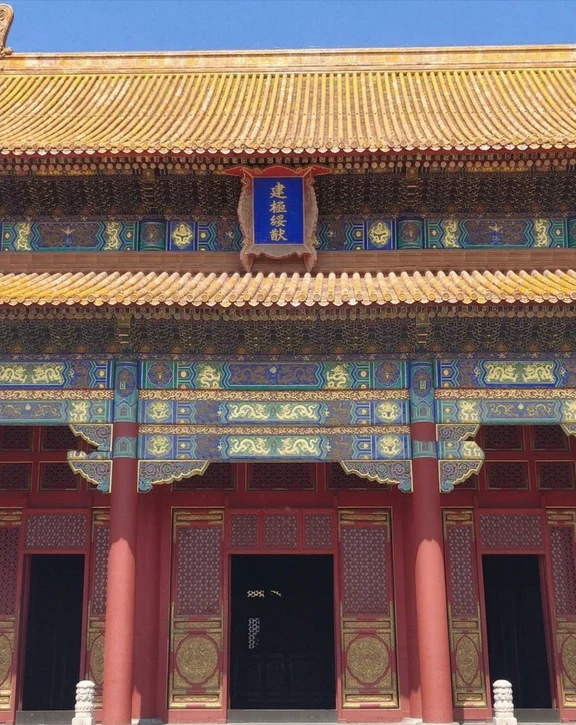
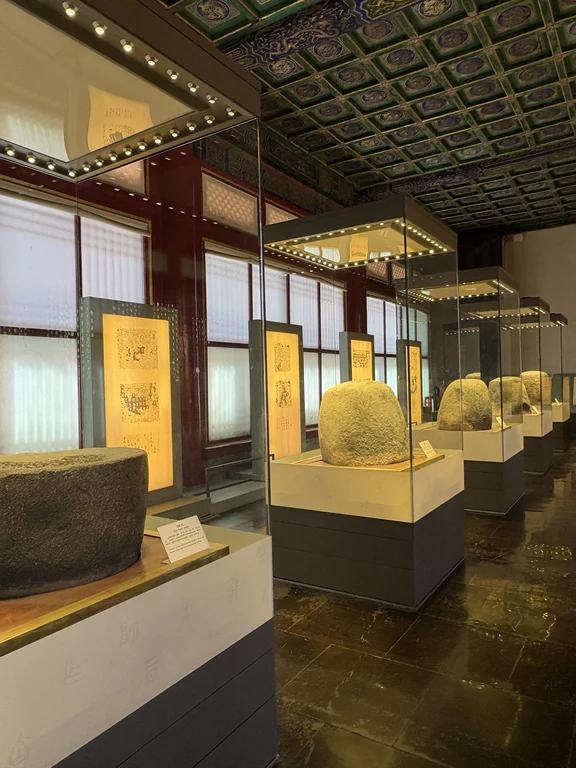
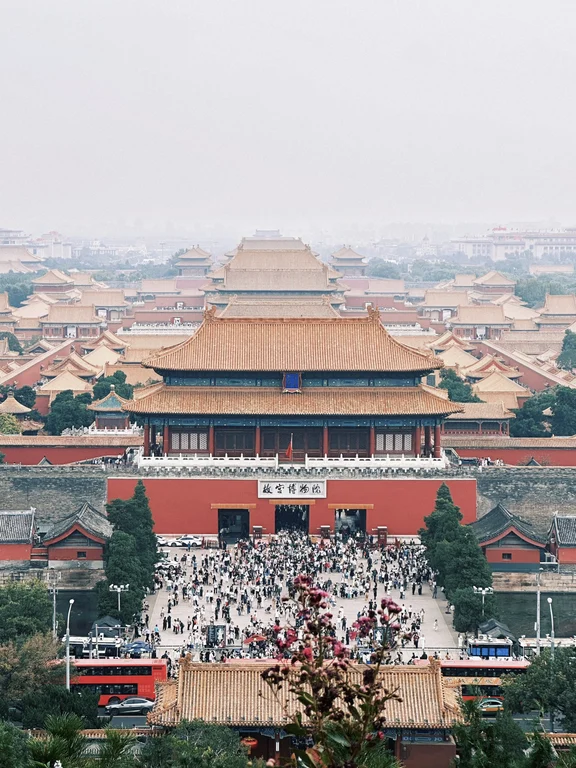
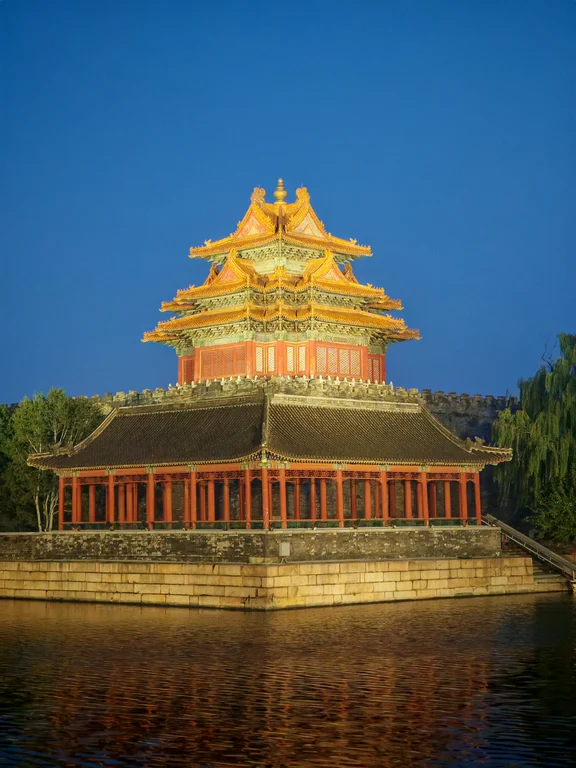
The Palace Museum is the imperial palace of the Ming and Qing dynasties — the Forbidden City — sitting at the centre of Beijing's north–south axis. It is the largest and best-preserved timber-frame palace complex still standing anywhere. Beyond the halls themselves it holds more than 1.8 million objects, which is what makes it a museum as well as a monument.
The basics
- Ground area
- About 720,000 square metres, holding more than seventy halls and some nine thousand rooms.
- Layout
- Laid out symmetrically on the north–south axis in two halves: the outer court, centred on the Hall of Supreme Harmony, the Hall of Central Harmony and the Hall of Preserving Harmony, and the inner court, centred on the Palace of Heavenly Purity, the Hall of Union, the Palace of Earthly Tranquility and the six eastern and six western palaces.
- History
- Begun in 1406, the fourth year of the Yongle reign, and substantially complete by 1420. It saw out close to five hundred years of dynastic change and court life under the Ming and the Qing, and became the Palace Museum in 1925.
Tickets and booking
- Ticket price
- Peak season, 1 April to 31 October, 60 yuan for the main ticket. Low season, 1 November to 31 March, 40 yuan.
- The two halls that charge separately
- The Treasure Gallery in the Palace of Longevity and Health and the Clocks Gallery in the Hall of Ancestral Worship are 10 yuan each and are not part of the main ticket. Tick them when you book rather than paying twice at the gate.
- How to book
- Everyone books by real name and there is no ticket window on site at all. Booking is through the Palace Museum WeChat mini-program or the official website.
- When tickets are released
- Seven days ahead at 20:00, and no same-day tickets are sold. Peak season and public holidays go quickly — set an alarm and be on the page at the minute.
- Discounts and free entry
- Chinese citizens under 18, retired cadres and disabled visitors get the main ticket free but still have to book. Students at undergraduate level and below pay 20 yuan; visitors aged 60 and over pay half.
Opening hours
- Peak season (1 Apr – 31 Oct)
- Opens 8:30, last entry 16:00, closes 17:00.
- Low season (1 Nov – 31 Mar)
- Opens 8:30, last entry 15:30, closes 16:30.
- The two halls that charge separately
- The Treasure Gallery and the Clocks Gallery usually stop admitting 10 to 20 minutes before the palace closes. Do not leave them until the end.
- Closing day
- Closed all day on Mondays, public holidays excepted. Check a calendar before you fix the date.
Routes through it
The visit is one-way: the Meridian Gate is the only way in, and you leave through the Gate of Divine Prowess or the East Glorious Gate. Walking it the other way round is not possible.
- The central axis (2–3 hours)
- For a first visit, or a short one. Meridian Gate, Hall of Supreme Harmony, Hall of Central Harmony, Hall of Preserving Harmony, Palace of Heavenly Purity, Hall of Union, Palace of Earthly Tranquility, Imperial Garden, Gate of Divine Prowess.
- Half a day, in depth (4–5 hours)
- The realistic choice for most visitors, taking in both the architecture and the collections: the central axis plus the Treasure Gallery and the Clocks Gallery.
- The ginkgo route (best in early November)
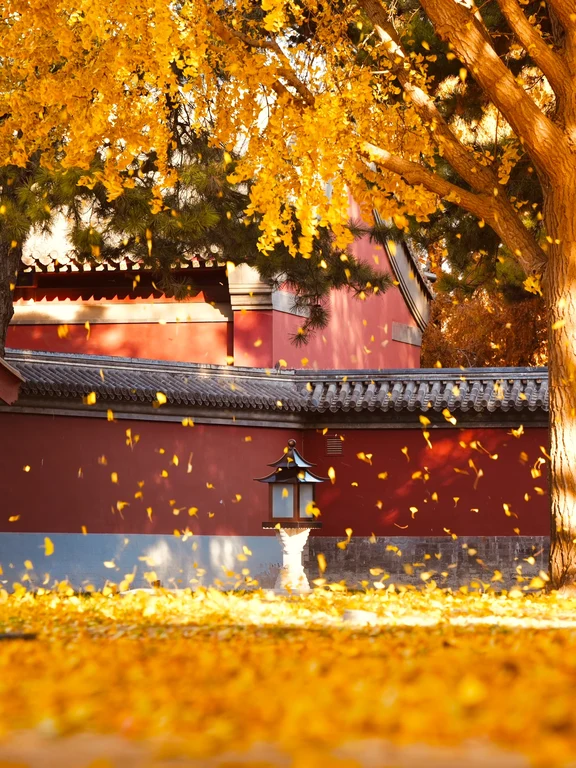
- For photographers and anyone who came for the trees. Meridian Gate, the Eighteen Cedars — the largest stand of ginkgos in the palace — the Palace of Prolonged Happiness, where century-old ginkgos stand against Western-style brickwork, the Garden of Compassion and Tranquility, and the Hall of Literary Glory.
- What to do as you leave
- Out through the Gate of Divine Prowess, cross the road into Jingshan Park and climb to the Pavilion of Ten Thousand Springs. From there the whole palace and the axis lie below you, and at sunset it is the best hour of the day.
Getting there
- Metro
- Line 1 to Tiananmen East or Tiananmen West. Or Line 8 to Jinyu Hutong and walk to the East Glorious Gate before heading for the Meridian Gate — that approach sometimes skips part of the security queue.
- Bus
- Several routes serve Tiananmen East, Tiananmen West and the Gate of Divine Prowess.
- Driving
- There is no dedicated car park and traffic control around the palace is strict. Take public transport.
What catches people out
- Bring the document you booked with
- Bring the original document you booked under — an ID card, for most visitors. Entry is by scanning it, and without it you do not get in.
- The touts
- Ignore anyone at the gate, or online, offering to book a slot for you or to give you a free guided tour. Use the official mini-program and a licensed guide.
- Wear for walking
- The place is vast and ten thousand steps is an ordinary day here. Wear soft soles, and bring a water bottle and a power bank.
- Left luggage
- There is free left luggage inside. Drop the big bag first and walk the palace light.
- Check before you go
- Check the official notice before you travel. Individual halls — the Hall of Martial Valour and the Palace of Prolonged Happiness among them — close at short notice for conservation work or an exhibition changeover.
How it was built
- Joinery and drainage
- Not one piece of steel: the structure works entirely on timber, mortise-and-tenon joints and bracket sets, which is why it has ridden out earthquakes. Roofs, terraces and paving together make a drainage system that has been running for six hundred years.
- The corner towers
- The four corner towers carry a cross-ridge roof that the old craft manuals describe as nine beams, eighteen columns and seventy-two ridges. They are the high point of the whole architectural language.
- Temporary exhibitions
- The palace runs major temporary shows year-round — recently a Tang and Song painting and calligraphy exhibition. Dates and rooms are announced on the official mini-program only, and some shows need a separate booking.