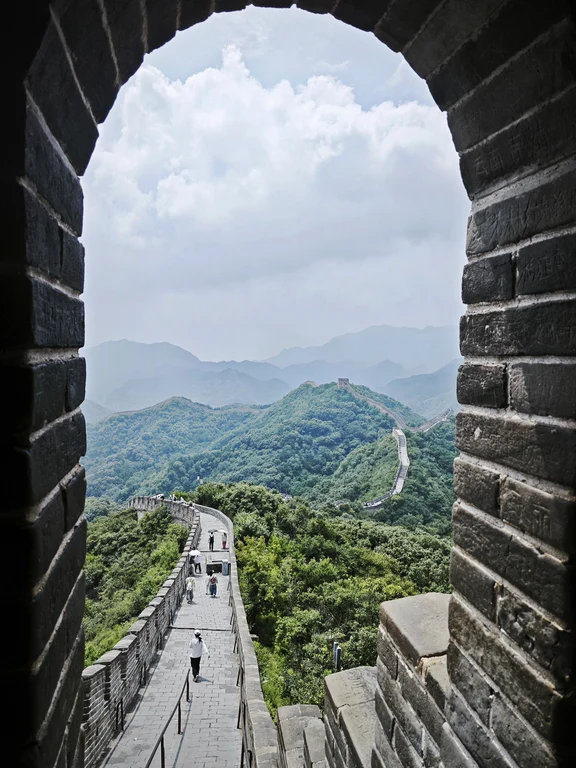
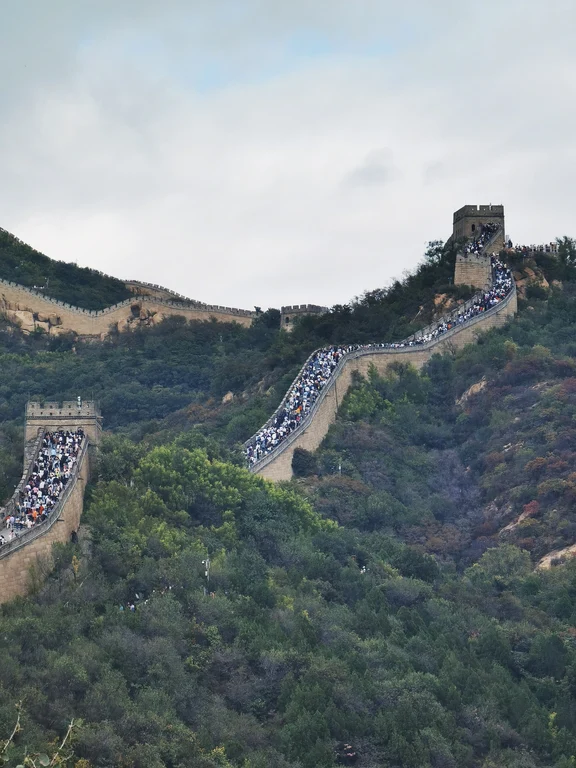
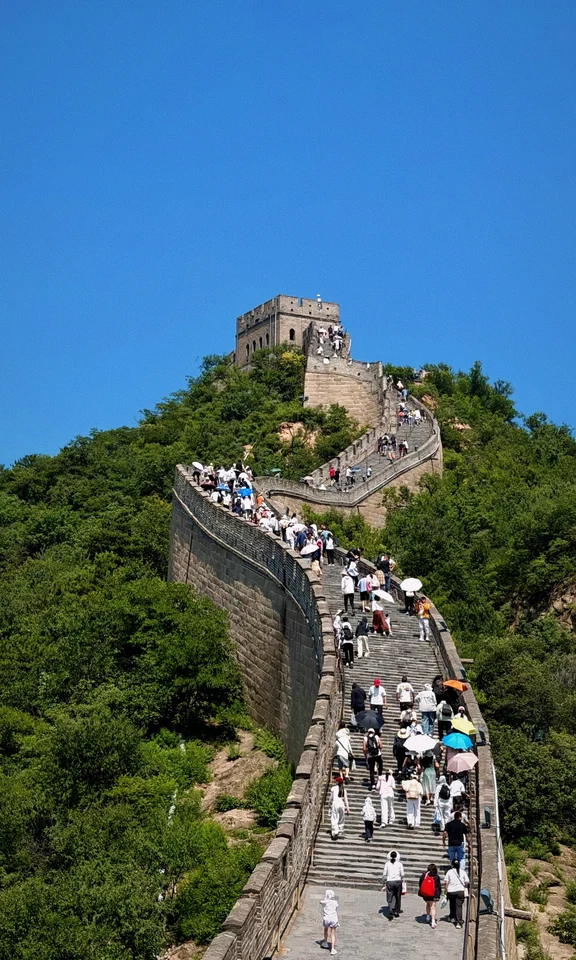
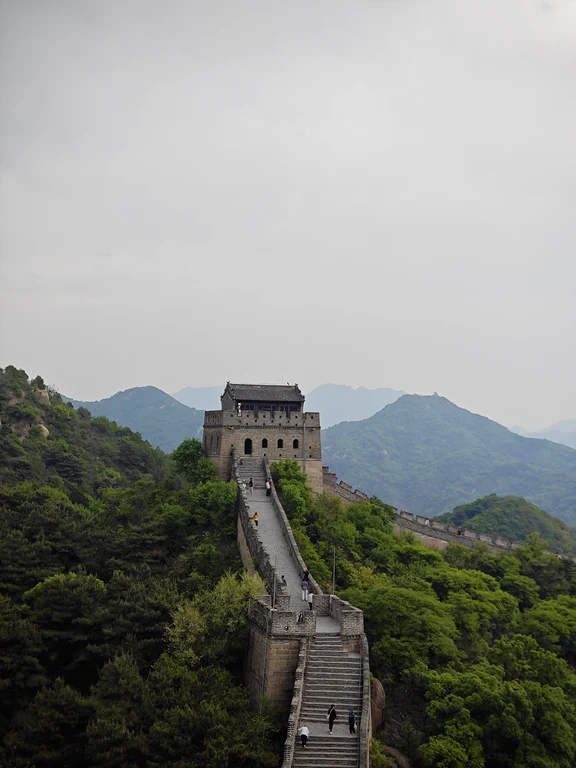
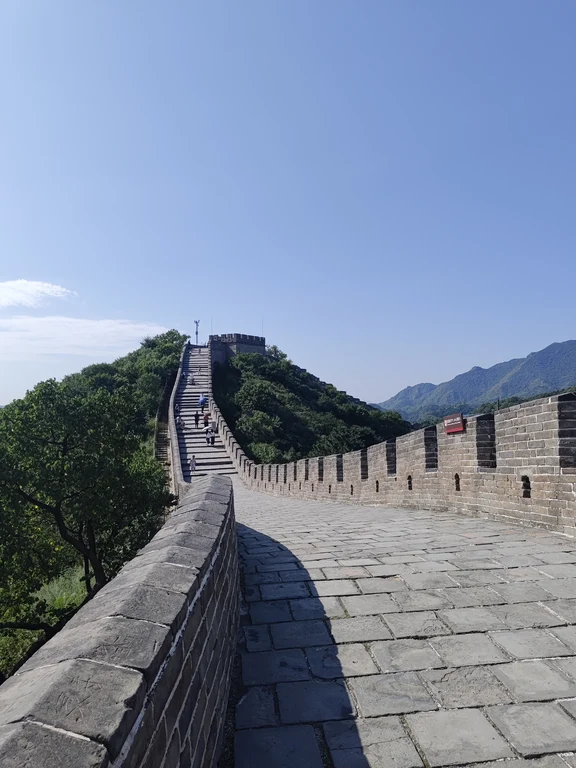
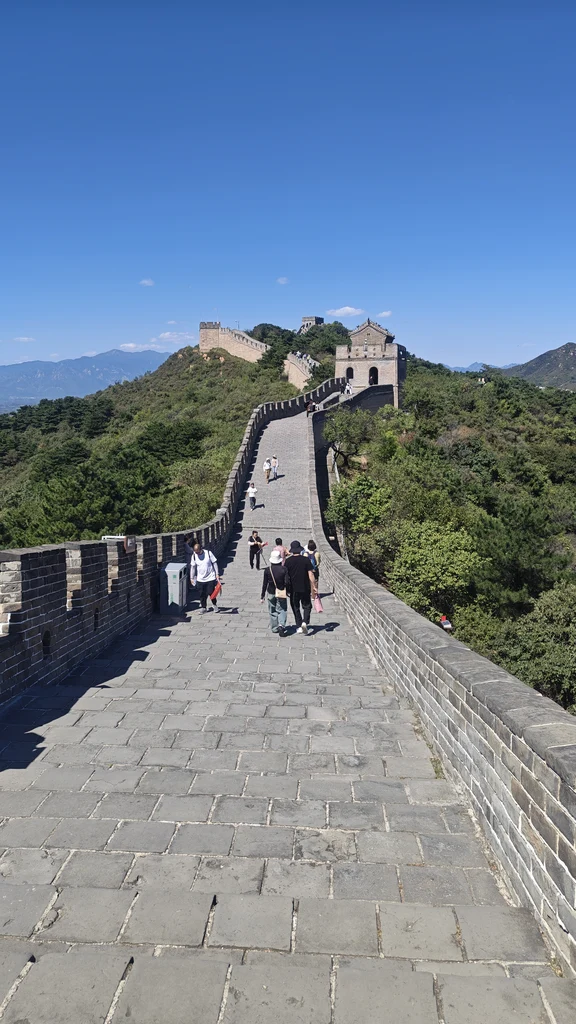
Badaling is the best-preserved and longest-open stretch of the Ming wall, listed as a World Heritage Site in 1987. The site divides into a north line and a south line: the north is grand and steep, the south gentler and quieter, so there is a version for each level of fitness.
Getting there
- High-speed rail (first choice)
- The Zhangjiakou high-speed line from Beijing North or Qinghe station to Badaling Great Wall station: 20 to 30 minutes, 20 to 30 yuan for a second-class seat. From the station it is a 10 to 15 minute walk to the wall entrance, and a very long escalator carries you up out of the station. Book early — peak-season seats are tight.
- Direct bus
- Route 877 from Exit B of Beitucheng metro station, or from the Deshengmen archery tower. About 1.5 to 2 hours each way, 6 yuan. Watch the last bus back in the afternoon, usually between 16:30 and 17:00 — do not cut it fine.
- Driving
- Navigate to Badaling P1 car park or Chaxi car park. On public holidays be there before 07:00, or expect traffic on the way in and a full car park.
Tickets and booking
- Ticket price
- Peak season, 1 April to 31 October, 40 yuan per adult. Low season, 1 November to 31 March, 35 yuan.
- How to book
- Real-name booking in advance through the Badaling Great Wall WeChat account or the Changcheng Online mini-program. Entry is by scanning your ID card.
- Free entry
- Under 18, over 60, serving military and disabled visitors pay nothing for the ticket, but they still have to book a zero-yuan one to get through the gate.
Which line to walk
The north and south lines do not connect along the top of the wall. To walk both you have to come back down to the entrance and start again, so pick one main line and match it to your legs.
- The north line, the classic one (3–5 hours)
- From the entrance past North Tower 1 up to North Tower 8 — the high point at 888 metres, and the stretch that appears in every photograph. With energy left, carry on to North Tower 12 and come down at North Tower 11, past the bear park, back to the entrance. Three to five hours, steep, and a real test of fitness.
- The south line, the easy one (2–3 hours)
- From the entrance past South Tower 1 to South Tower 4 — the high point of the south line, looking straight across at the whole north line — then on to South Tower 7. Gentle throughout, far fewer people, and much the better photographs. Two to three hours. Suits older visitors, children and anyone who would rather not climb.
- The cable option
- On the north line a cable car runs up to North Tower 7, leaving a short walk to North Tower 8; on the south line a ground-level cable car goes to South Tower 4. About 100 yuan one way, 140 yuan return. The choice for older visitors, small children, or limited stamina.
What catches people out
- The touts
- Do not take the guides who approach you on the road, the cheap day tours, or the old woman offering to lead the way. Use the official train and the Beijing tourist transport centre. The cable-car pitch on official coaches exaggerates the distance: the car park to the walking entrance is a few hundred metres, a few minutes on foot.
- What to wear
- There is almost no shade up there: hat, sunglasses and sunscreen are essential. The steps are worn smooth and the descent is hard on knees, so wear shoes that grip and consider a knee support. The ridge is windy and colder than the city — dress in layers and bring a windproof outer.
- What to carry
- Bring water and a few energy snacks; prices inside the site are high. Use the toilet before you go in, because there is none on the wall.
- The hero certificate
- Coming down, on the commercial street, there is a counter giving out a hero certificate: free if you only want the name written, 3 yuan to add a seal and a laminate. Worth the three yuan.
- Watch the clock
- If you are going back by train, avoid descending through the bear park — it is a long way from the station entrance and people miss their train that way.